
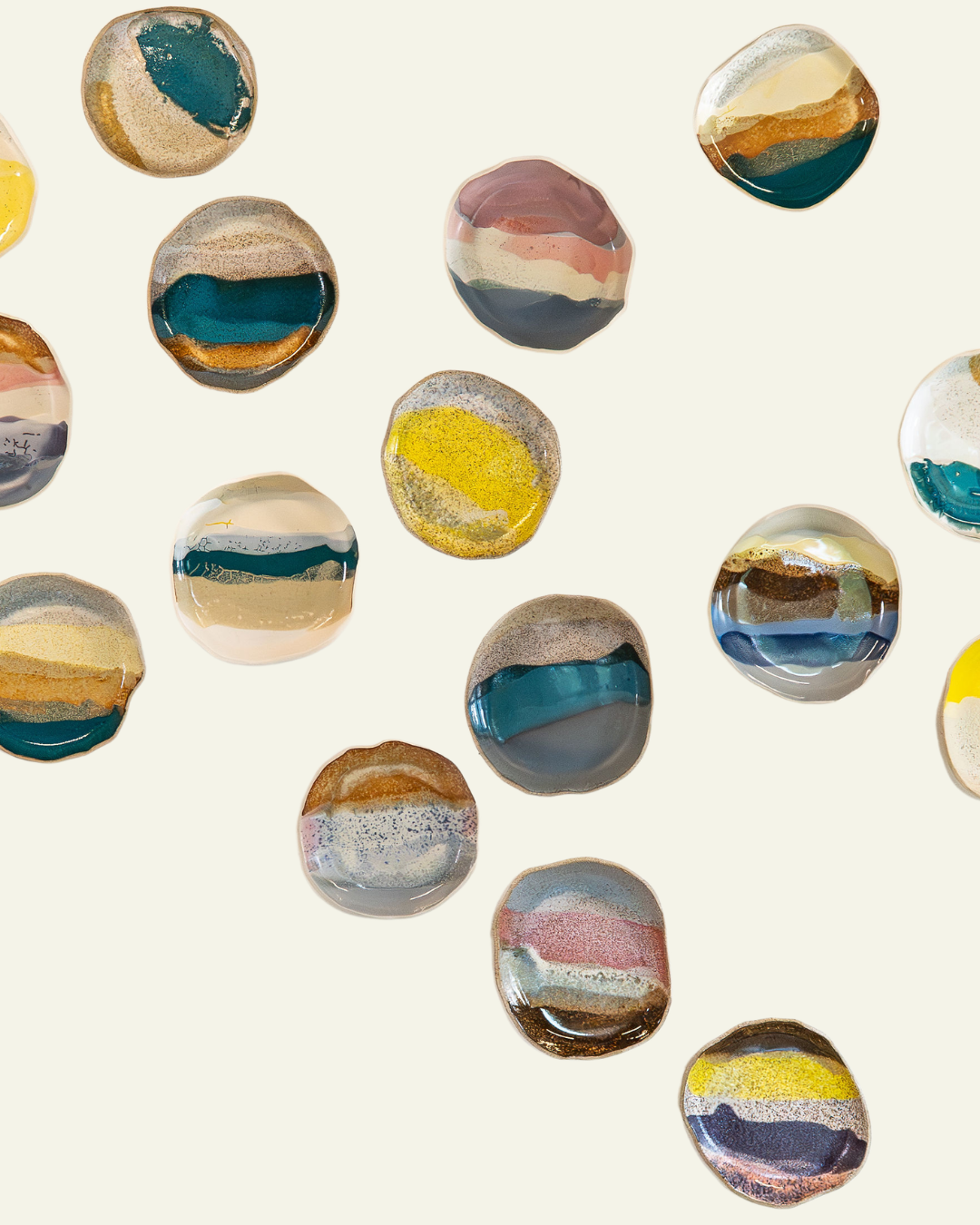
A Second Look
Landis Carey's Ceramic Art London Collection Expansion
Landis Carey is an American ceramic artist whose immersive wall installations explore the emotional and perceptual life of color. As a synesthete, Carey experiences color during meditation as both something seen and something felt, a temperature, a sound, a physical sensation. It’s that resonance she works to translate into her clay forms. Her installations don't just ask to be looked at; they ask to be felt, inviting quiet contemplation and a real, embodied connection to the work.
Expansion was never meant to be a single composition. Landis Carey built it as a large-scale, modular installation using dozens of individual ceramic forms designed to grow, contract, and rearrange across a surface, each element in quiet conversation with the ones beside it. The installation was built to never settle into a fixed arrangement, which means no two encounters with it are ever quite the same.
At Ceramic Art London, Expansion presented as one continuous body before an international audience as a single, sprawling statement. Now that it is unpacked and laid out across the table in Landis’s studio, it has become something else yet again: individual objects, each carrying the full emotional charge of Landis's intentional practice, accessible at a scale you can live with.
This selection, A Second Look, is drawn from the revisit. To pull individual pieces from Expansion isn't to break the whole, it's to let each modular element step forward and be held on its own terms. This is how the work was always meant to live on - into new configurations, into new hands and into new spaces. The synesthetic understanding of color that runs through Landis's practice where a hue is never just a hue but a temperature, a sound, a feeling, lives as completely in each individual element. On its own, a single piece has the same impact as the entire installation. It asks you to slow down and read it closely, the way you might not in a crowded fair hall.
I've had the privilege of working alongside Landis through the full life of this work watching these forms take shape in the studio, readying them for their journey across the Atlantic, and revisiting the pieces again when they returned home. There's a particular intimacy in seeing a body of work exist in different places and iterations. Time and place do something to the way you see. A piece that lived inside a larger gesture in London reads differently alone on a table in an artists studio. That shift is exactly what this selection is built around. That second look is where these selected groupings come from.
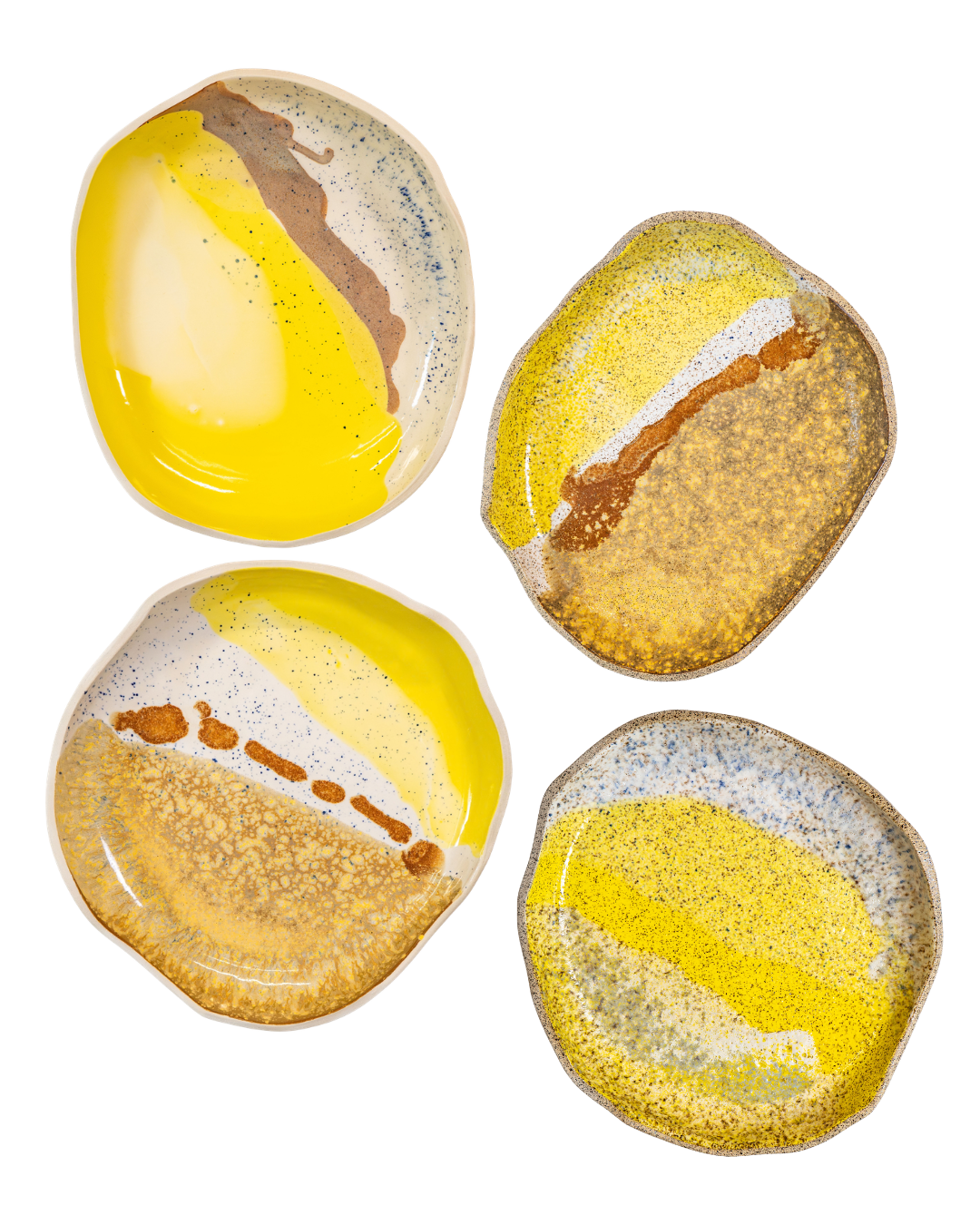
Yellow Grouping - “Grounded in Light”
The most vibrant of the three groupings, and the one where the clay speaks loudest. These four pieces evoke the essence of yellow. They are sensational; bright, playful, alive and never flat. Each surface is built in layers that reward a longer look.
In three of the four surfaces, rich browns and ochres rise up through the yellow, pulling the pieces back toward the earth they came from, grounding the brightness in something rooted. These subtle swaths of clay colored glaze gives the group a particular tension: forms that feel at once of the natural world and slightly beyond it, familiar and otherworldly in the same breath.
There's a curiosity running through these, an openness, a sense of light arriving.
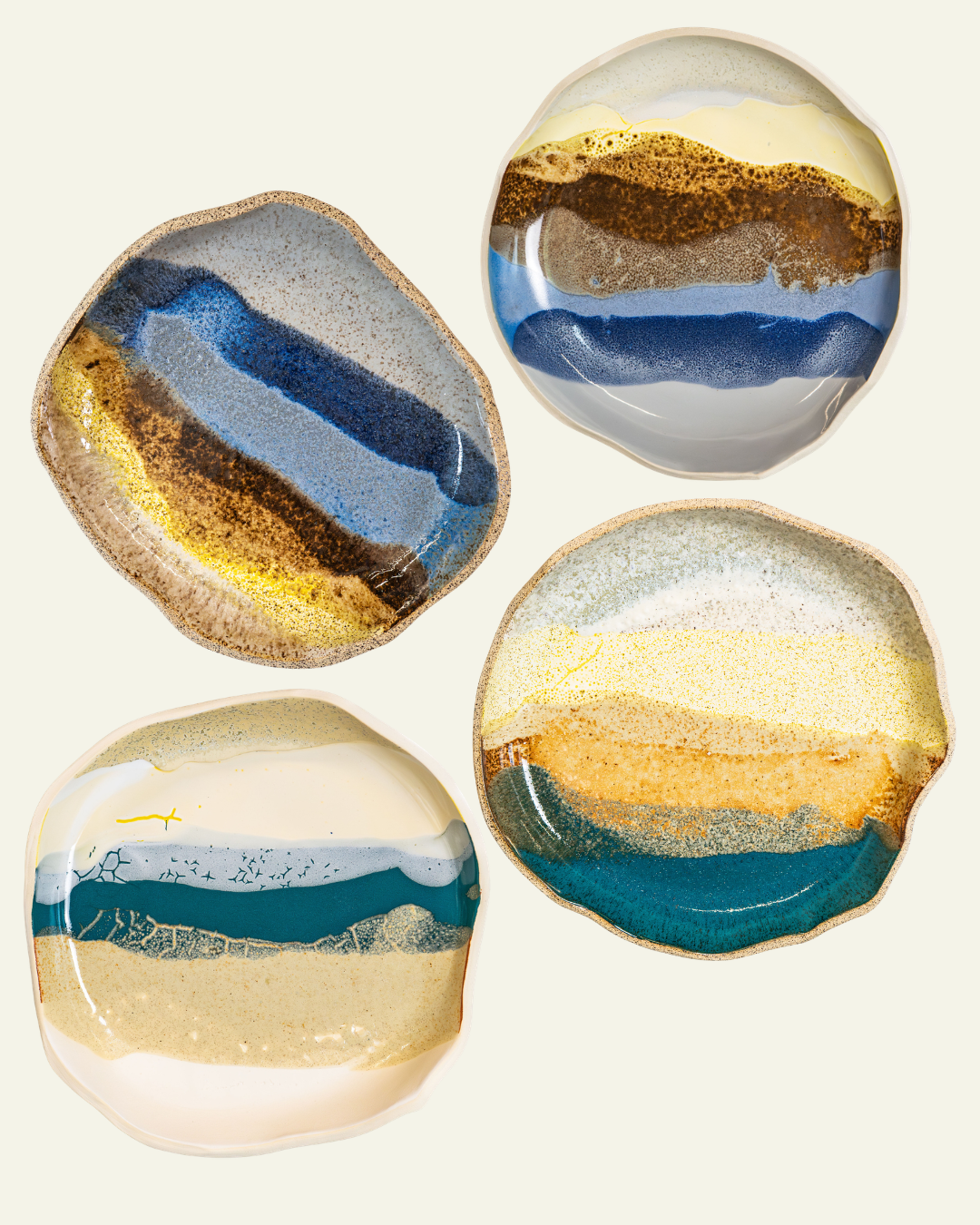
Blue Grouping - “The Deep End”
If Expansion has a center of gravity, it's here in this collection of blue surface. Blue in all of it’s values runs through Landis's practice for years, and is pulled forward on their own terms. These four pieces show why: this is where the layers of glazes do its most searching work, built up in passes until the surface holds light rather than reflects it. The values of blue move from deep, saturated blues through a cooler wash of turquoise and aqua into earthen browns, with the occasional flash of gold breaking the surface.
For all that experimentation, the feeling is stillness: earthy, familiar, quieting. Held on their own, away from the crowd of the larger installation, they read as striking and grounding at once provoking a neutral, almost comforting register that asks you to slow down and stay a while.
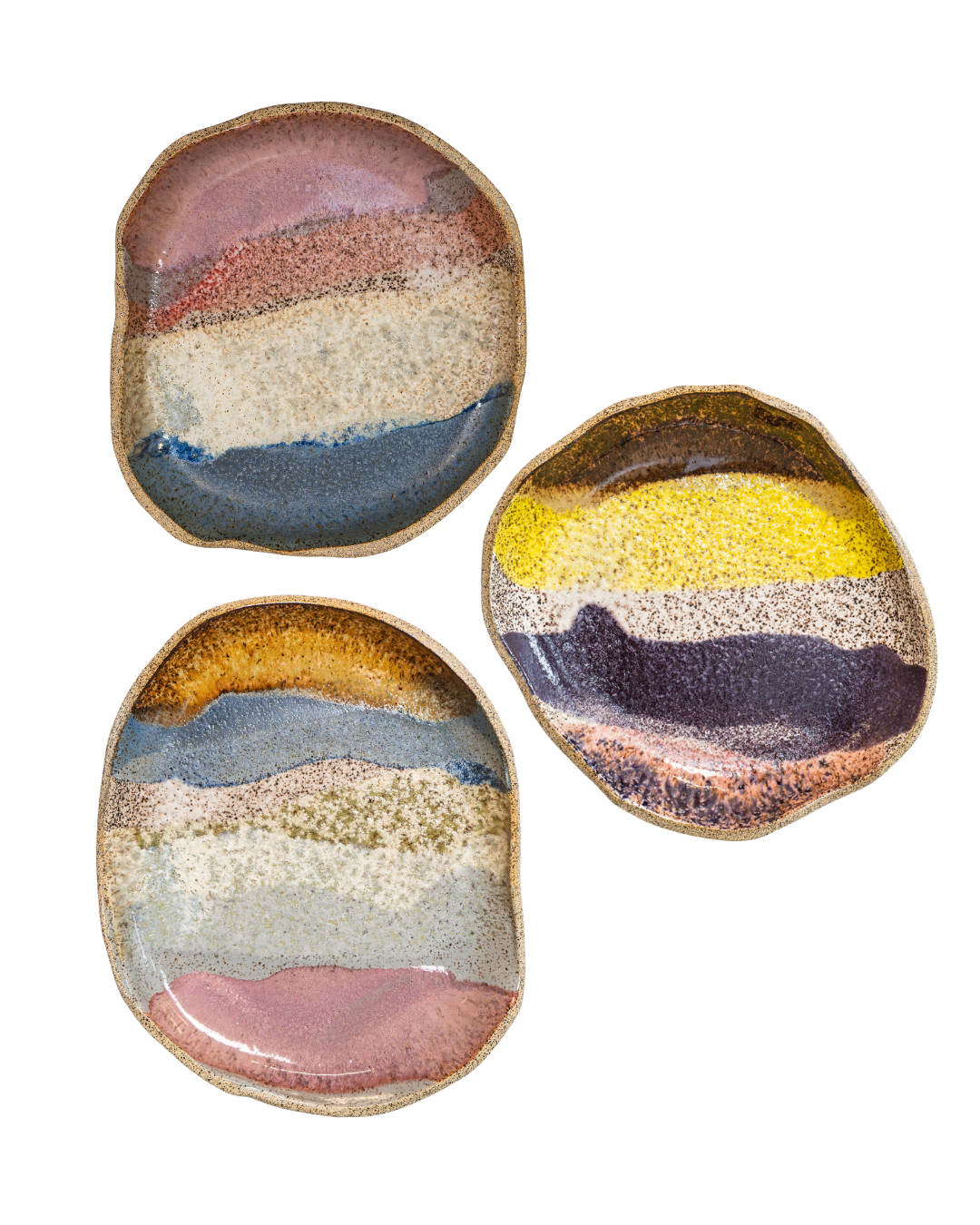
Pink Grouping - “Warm Front”
The warmest of the three collections, and the most quietly surprising. Pulled from Expansion these four ceramic surfaces lead with soft, subtle pinks evoking a register full of familiarity and nostalgia, something almost sweet. If you look longer the beautiful layering opens up: blues, ochres, and rich eggplant moves through and against the pinks, each color sharpening the ones beside it.
These pieces, to me, acknowledge Landis's synesthetic sense of color the most overtly. The color pairings turn playful and become less about a single hue and more about the conversation between several. The effect is warm and easy but never simple. Each surface evokes a sense of cool confidence in the softness of the final color composition.
To experience Expansion as a whole was to feel the full weight of Landis's vision at once. To meet these pieces individually is something quieter and, in its own way, just as complete. Each one carries the same synesthetic charge, the same layered attention, the same invitation to slow down and feel your way through color. Removed from the crowd and held on their own, they ask a more intimate question: not how a room full of artwork moves you, but how a single piece does, in your hands and in your space.
These groupings were composed with an eye to color balance and composition, but they're an invitation rather than a set. Every surface is available on its own, allowing for flexibility in how you collect. Choose a full grouping, your own small constellation or an individual work. However these forms find their way to you, they have more to say.
For more information about collecting, please click the link below.